

From Zimbabwe's forests to California's carbon market, companies are buying promises of climate protection while continuing to pollute. The money is real, but the carbon savings are not always what they seem.
Imagine running a business that produces pollution, then paying someone thousands of miles away to protect a forest so you can claim you've made up for it. Your factory keeps running, your emissions continue, and your company gets to advertise its commitment to fighting climate change. Meanwhile, an industry of brokers, consultants, and project developers earns money arranging these deals.
This is the basic idea behind carbon offsets, a system that allows companies to compensate for their greenhouse gas emissions by paying for projects that supposedly prevent pollution elsewhere or remove carbon dioxide from the atmosphere. One carbon credit typically represents one metric ton of carbon dioxide, or an equivalent amount of another greenhouse gas, avoided or removed.
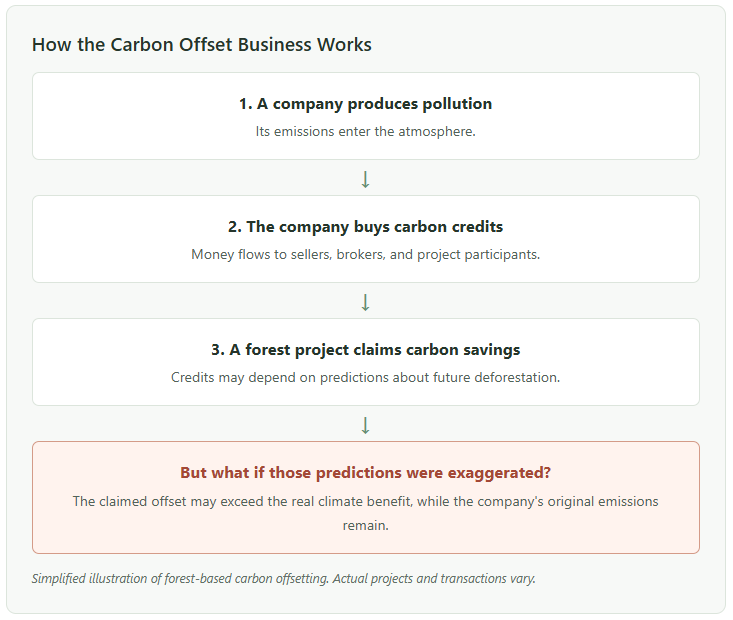
The problem is that many credits are based on estimates of what might have happened without the project. A forest owner, for example, can earn credits by promising to prevent trees from being cut down. But how do we know those trees were ever in danger? And who decides how much carbon was actually saved?
Those questions have exposed serious problems in a market where credits can be sold based on predicted climate benefits that may later prove exaggerated.
When a Forest Becomes a Financial Product
In Zimbabwe, the Kariba forest conservation project sold millions of carbon credits to companies seeking to offset their emissions. The project was supposed to protect forests and support nearby communities, but its calculations greatly overstated how much deforestation it prevented.
In September 2025, Verra, the organization that certified the credits, confirmed that approximately 15.2 million of the 26.8 million credits issued were excessive. That means nearly 57% of the issued credits exceeded the climate savings supported by revised calculations.
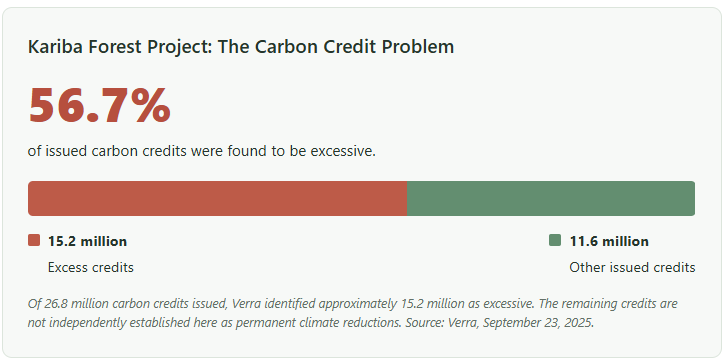
Some of those credits had already been used by companies to support their climate claims. Verra sought corrective action, but previously retired credits remained valid in its registry.
The pollution those companies produced had already entered the atmosphere. Correcting the accounting afterward could not undo those emissions.
California Has Its Own Carbon Accounting Problem
This is not just a problem in distant forests. California allows certain large polluters to use approved carbon offsets to meet a limited portion of their obligations under the state's carbon trading program, which puts a price on greenhouse gas emissions.
In 2021, researchers from CarbonPlan examined California's forest-offset program and estimated that nearly 30 million credits, worth about $410 million at the prices they studied, did not represent real additional carbon savings. California regulators disputed those findings and defended the program's accounting methods.
Unlike voluntary offsets purchased for advertising claims, California's approved credits can help companies meet legal requirements. That makes accurate accounting especially important.
There is also a problem for communities living near refineries and other industrial facilities. Even when a forest credit represents a genuine climate benefit, it does not remove the soot, smog-forming gases, or other harmful pollution released near someone's home. A refinery can meet part of its climate obligation by buying offsets while nearby residents continue breathing pollution from its operations.
The Business Model Rewards Selling Credits
Carbon markets were designed to put a financial value on reducing emissions. In theory, that encourages companies to protect forests and invest in cleaner practices. In reality, the system also creates opportunities to make money by producing, verifying, trading, and selling credits.
The more credits a project can justify, the more potential revenue it generates. That creates a financial incentive to make estimated climate benefits look as large as possible, even though verification rules are supposed to prevent exaggeration.
Protecting forests is important, and well-designed conservation projects can provide real environmental and community benefits. But protecting a forest is not the same as eliminating fossil fuel emissions. Trees can burn, die, or be cut down, while carbon dioxide from burning oil, coal, and gas can affect the climate for centuries.
The deeper problem is that carbon offsets allow companies to treat continued pollution as something they can balance through financial transactions. When credits are overstated, the claimed balance disappears, but the original pollution remains.
We have created a market where companies can pay to claim climate progress, intermediaries can earn money selling that claim, and the public is left relying on calculations that may prove wrong years later. Real climate progress should be measured by how much pollution we actually stop producing, not by how many promises we manage to sell.
References & Sources
- Verra (September 23, 2025). Verra Acts on Kariba Project: Cancels Excess Credits, Advances Independent Review. Official findings on the 15.2 million excess credits.
- Badgley et al. (2022), Global Change Biology. Systematic Over-Crediting in California's Forest Carbon Offsets Program. Peer-reviewed study estimating 30 million excessive credits with a market value of approximately $410 million.
- CarbonPlan (2021). Systematic Over-Crediting of Forest Offsets. Research explanation and supporting analysis of California's forest-offset program.
- California Air Resources Board. Cap-and-Trade Program Frequently Asked Questions. Background on California's carbon trading system and offset requirements.
10/15/2026 – This article has been written by the FalseSolutions.Org team
Share this

