
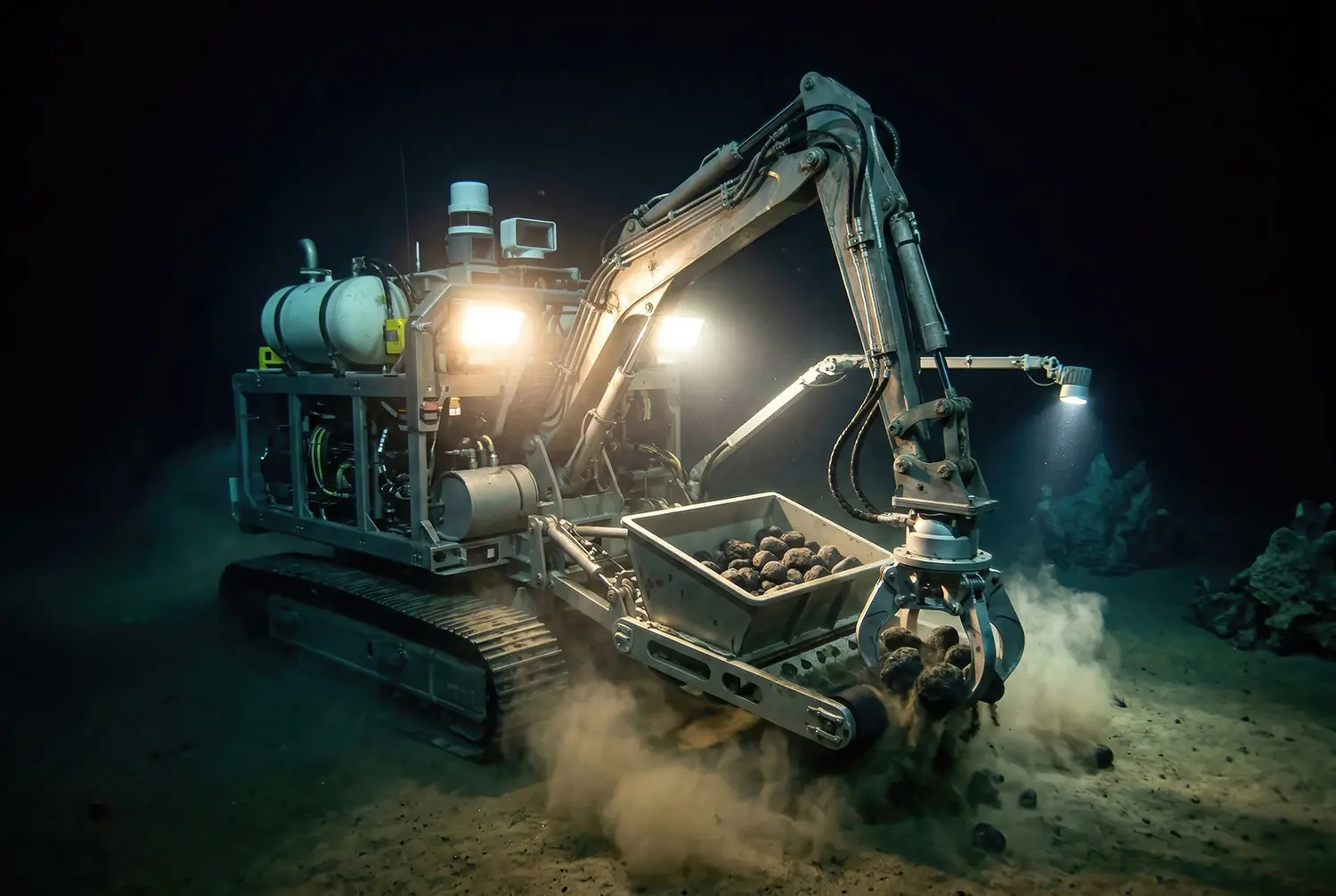
For most of human history, the deepest parts of the ocean were protected by something surprisingly simple: we could not easily reach them. Miles below the surface, in darkness and crushing pressure, the seafloor remained largely beyond the reach of mines, highways, factories and bulldozers.
Technology is beginning to change that, and the United States is moving closer to opening part of the deep ocean to commercial mining.
In July 2026, the federal government advanced plans for a mineral lease sale in federal waters around American Samoa. The proposed leases would give companies access to areas of the seafloor containing valuable minerals used in batteries, electronics, transportation, energy systems and military equipment. Federal officials argue that developing domestic supplies of these materials could reduce U.S. dependence on foreign mineral supply chains.
There is a certain logic to that argument, but there is also a very large problem beneath it. We are considering industrializing ecosystems we barely understand before exhausting the less destructive options available above the water.
What Exactly Are We Mining?
Deep-sea mining sounds like drilling a hole into the bottom of the ocean, but one of the main targets is something stranger. Across parts of the deep seafloor are rocks called polymetallic nodules, often roughly potato-shaped, that formed extremely slowly over millions of years.
These nodules can contain manganese, nickel, copper and cobalt. Those metals have many uses, including batteries, electrical equipment and other modern technologies.
Mining them would involve sending large machines thousands of feet down to the seafloor, where they could collect nodules while disturbing the sediment around them. Material would then be transported toward the surface for processing.
The nodules, however, are not simply loose rocks sitting on an empty underwater parking lot. They are part of an ecosystem.
Research has found diverse communities of organisms living in and around nodule fields. Mining machines can physically disturb the seabed and create clouds of sediment that move beyond the immediate mining path. A 2025 study of a deep-sea mining equipment trial documented disturbed sediment traveling kilometers from mining lanes.
Scientists are still working out what those disturbances would mean at commercial scale, and that uncertainty matters because the deep ocean operates on timelines very different from ours. Research published in Nature in 2025 examined an experimental mining disturbance conducted more than four decades earlier. Scientists found that some organisms had returned, but the directly disturbed communities remained altered and physical changes to the seafloor were still visible after 44 years.
When something takes millions of years to form, promises that we can simply restore it later become difficult to take seriously.
American Samoa Has Already Said No
The location of the proposed U.S. lease sale makes the story even more troubling.
American Samoa’s government imposed a moratorium on deep-seabed mining exploration and exploitation in its territorial waters in 2024. In June 2025, the governor, lieutenant governor, American Samoa’s congressional delegate and legislative leaders announced unified opposition to proposed commercial mineral leasing in the surrounding federal waters.
Yet the federal leasing process continued.
In July 2026, federal officials announced a proposed leasing notice for waters around American Samoa, moving the process closer to a competitive lease sale. The federal government says the minerals could strengthen U.S. supply chains and has proposed requirements encouraging future operators to hire American Samoans, use local businesses and make use of the Port of Pago Pago.
Those possible economic benefits do not erase the larger question of who gets to decide what happens to an ocean surrounding an island community.
For Pacific peoples whose food, economy, history and culture are closely connected to the ocean, the seafloor is not simply an untapped warehouse of minerals.
The Green Transition Needs Minerals, but That Is Not the Whole Story
Supporters of deep-sea mining have one important point that should not be dismissed: the modern economy needs enormous quantities of minerals.
Solar panels, electric vehicles, batteries, power lines and many other technologies require metals. The International Energy Agency reported that demand for key energy minerals continued rising rapidly in 2025 as renewable energy, electric vehicles, batteries and electrical grids expanded.
Pretending we can build a cleaner economy without mining anything would not be realistic, but accepting the need for minerals does not automatically mean every new source of minerals is necessary or wise.
Battery chemistry is changing. Manufacturers can reduce or eliminate the use of certain expensive metals in some applications. Recycling is also becoming increasingly important. The International Energy Agency estimates that recycled materials could eventually provide a significant share of lithium, nickel and cobalt needed for batteries, particularly as today’s electric vehicle batteries reach the end of their useful lives.
Better collection systems, longer-lasting products, battery reuse and improved recycling will not eliminate mining, but they can reduce pressure to constantly open new extraction frontiers.
The Ocean Floor Should Not Become the Next Sacrifice Zone
Human history has a familiar pattern. We discover something valuable, declare the place containing it underused, extract as much as possible and study the damage afterward.
Forests became timber. Mountains became coal. Wetlands became real estate. Rivers became disposal systems. Now some of the least explored ecosystems on Earth are being described as mineral resources.
Environmental advocates sometimes use the term sacrifice zone to describe a place where pollution, environmental damage or health risks are accepted because the land or community is considered useful for industry. These places are often far from the people making the decisions, and the costs are frequently carried by communities with less political and economic power.
Deep-sea mining risks extending that same idea into a place where there are no neighborhoods, roads or voters to complain about what happens.
The absence of people living on the deep seafloor does not mean nothing lives there, and it does not mean the ecosystem has no value until someone discovers a profitable use for it.
Deep-sea mining may someday prove possible under rules that protect large portions of the ocean and limit damage. It may also prove that some places are simply too difficult to mine responsibly. We do not yet know enough to confidently answer that question, and that is exactly why rushing toward commercial extraction makes little sense.
The clean-energy transition should not repeat the mistakes of the fossil-fuel economy by treating another distant ecosystem as expendable. A genuinely better solution starts by reducing waste, recycling what we already extracted, designing technologies that require fewer scarce materials and making existing resources last longer.
The bottom of the ocean has survived without our help for millions of years. Before we turn it into the world’s next industrial frontier, the burden should be on us to prove that tearing it apart is truly necessary.
- U.S. Bureau of Ocean Energy Management. Potential American Samoa Offshore Minerals Lease Sale, 2026.
https://www.boem.gov/marine-minerals/potential-american-samoa-offshore-minerals-lease-sale - Government of American Samoa. Leadership United: Governor and Lieutenant Governor Lead Unified Effort on Seabed Mining, June 23, 2025.
https://www.americansamoa.gov/leadershipunited - Government of American Samoa. Executive Order 006-2024, Moratorium on Deep Seabed Mining Exploration and Exploitation Activities.
https://www.americansamoa.gov/executiveorders - Nature. Long-term impact and biological recovery in a deep-sea mining track, 2025.
https://www.nature.com/articles/s41586-025-08921-3 - Nature Communications. Monitoring benthic plumes, sediment redeposition and seafloor imprints caused by deep-sea polymetallic nodule mining, 2025.
https://www.nature.com/articles/s41467-025-56311-0 - Nature Reviews Earth & Environment. Deep-ocean polymetallic nodules as a resource for critical materials, 2020.
https://www.nature.com/articles/s43017-020-0027-0 - International Energy Agency. Global Critical Minerals Outlook 2026.
https://www.iea.org/reports/global-critical-minerals-outlook-2026 - International Energy Agency. Recycling of Critical Minerals.
https://www.iea.org/reports/recycling-of-critical-minerals - International Seabed Authority. The Mining Code: Draft Exploitation Regulations.
https://isa.org.jm/the-mining-code/draft-exploitation-regulations-2/
08/27/2026 – This article has been written by the FalseSolutions.Org team
Share this