
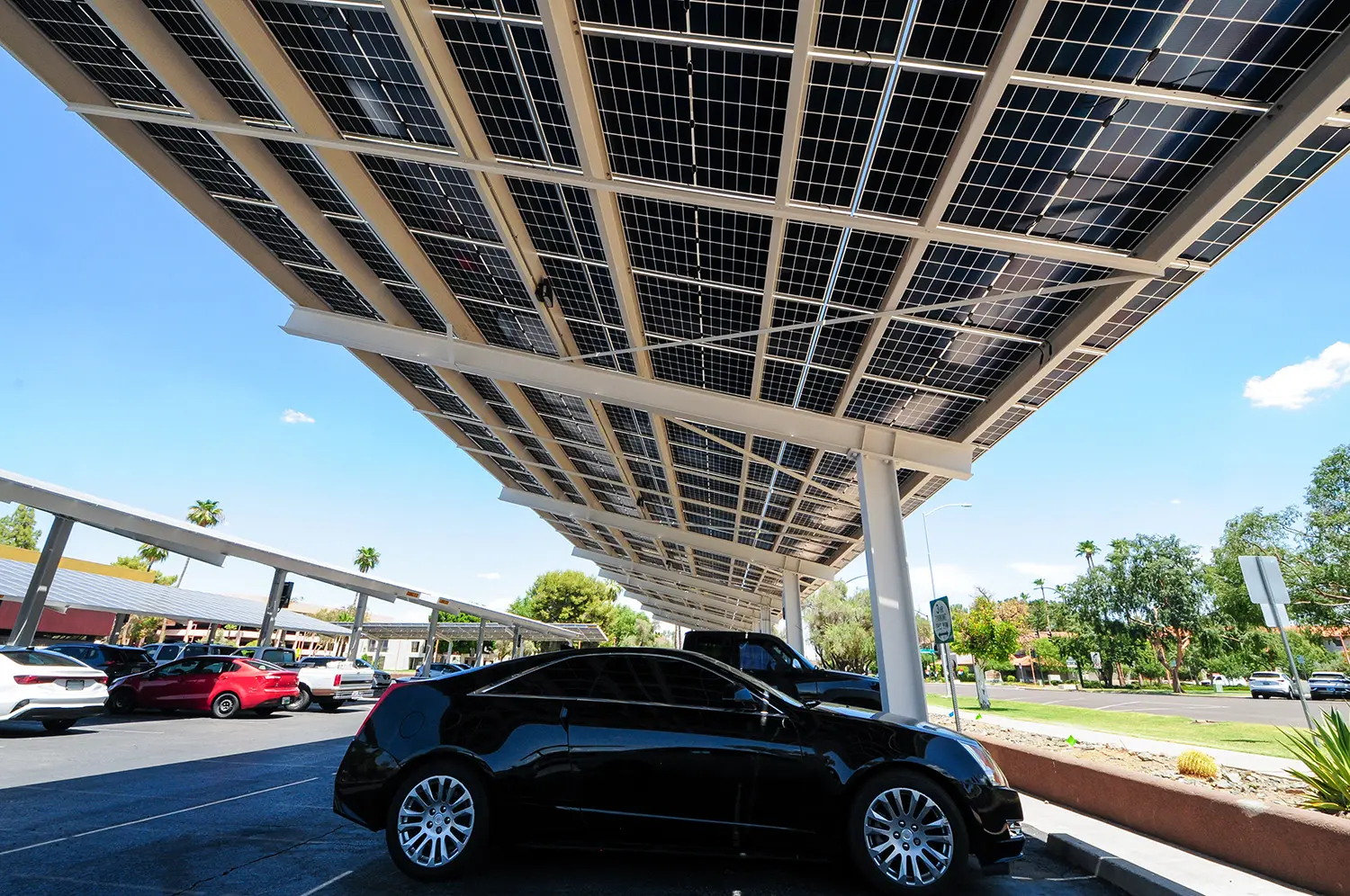
Across the United States, enormous stretches of land sit covered in asphalt. We call them parking lots, and for most of the day many of them do little more than wait for cars.
They surround shopping centers, airports, stadiums, schools, hospitals, warehouses and office buildings. They are such a familiar part of American life that we rarely think about what else this land could be doing. Yet as communities search for places to build more renewable energy, these already developed spaces deserve a much closer look.
Parking lots are normally one of the least productive parts of our built environment. They absorb sunlight, contribute to urban heat, shed stormwater and occupy enormous amounts of valuable land. Solar canopies turn at least one of those liabilities into an asset.
Instead of placing solar panels directly on the ground, a solar canopy raises them on a structure high enough for cars to park underneath. The same land can then serve two purposes. Cars still have somewhere to park, while the space above them produces electricity.
It is a remarkably simple idea, and one that could be used much more widely.
Turning Asphalt Into Energy
A large installation at JPMorgan Chase’s McCoy Center in Columbus, Ohio, offers one example of what this looks like at scale. Tens of thousands of solar panels have been installed across the property, including large canopies covering parking areas. The combined solar installations can provide a substantial share of the electricity used by the complex.
That is worth paying attention to, but not because JPMorgan Chase deserves a green halo. One solar project does not erase a corporation’s larger environmental footprint, investments or business practices. When companies promote a highly visible environmental project while distracting attention from more damaging activities elsewhere, that can become a form of greenwashing.
The more important lesson is that the technology works.
A 2025 study published in Environmental Research: Infrastructure and Sustainability examined parking lots in several very different American communities. Researchers estimated how much electricity could be produced if portions of these already developed areas were covered with solar canopies. They found enormous potential, particularly in lower-density communities where parking lots take up large amounts of land. In some of the areas studied, high-efficiency parking-lot solar could theoretically generate electricity comparable to the community’s total electricity demand.
That does not mean we can power the entire country by covering every parking space with solar panels. Some lots are too small, shaded or poorly located, and solar canopies generally cost more than simple ground-mounted solar because they require substantial support structures.
Still, the study points toward something we often overlook in the renewable energy debate. Before clearing another piece of land, we should ask what we can do with land we have already developed.
A Parking Lot Has More Than One Problem
Generating electricity is only part of the opportunity.
Anyone who has opened a car door on a hot summer afternoon knows how much heat a parking lot can collect. Asphalt and concrete absorb the sun’s energy during the day and release that heat back into the surrounding area. Across a city, roads, roofs, buildings and parking lots contribute to what scientists call the urban heat island effect, where developed areas become hotter than nearby places with more trees and vegetation.
Solar canopies interrupt some of that sunlight before it reaches the pavement and the vehicles below. The panels generate electricity while providing shade, making parked cars cooler and reducing some of the heat absorbed by the pavement.
There is another problem beneath our feet. Conventional asphalt does not absorb much water. During heavy rain, water runs across parking lots, collecting oil, tire particles, trash and other pollution before entering storm drains and waterways. This is known as stormwater runoff.
Solar panels alone do not solve that problem, but redesigning parking lots gives communities an opportunity to address several problems at once. Permeable pavement can allow more rainwater to soak into the ground. Trees and planted areas can provide additional shade while capturing water. Solar canopies can generate electricity, and EV chargers underneath them can use some of that electricity where it is produced.
Suddenly, a parking lot is doing much more than storing cars.
Other Countries Are Already Moving
France has gone much further than the United States in recognizing this opportunity. Under French law, many large outdoor parking lots are being required to provide shade across substantial portions of their area, with renewable energy incorporated into qualifying canopies. The rules are being phased in according to parking-lot size, with exemptions for certain technical, environmental and economic circumstances.
The exact French policy may not fit every American community, but the idea behind it deserves attention. Governments routinely establish rules for how parking lots are built, how many spaces developments must provide and how water must drain from a property. Requiring large parking areas to provide shade, produce electricity or manage stormwater is not a radical departure from that tradition. It simply asks that this land work harder.
A Good Solution Without the Greenwashing
Solar parking canopies are not going to solve climate change. They cannot replace every power plant, and they should not become an excuse to preserve unnecessary seas of asphalt. In places where parking can be reduced and land restored, planted with trees or turned into housing, parks or other useful spaces, that may be the better choice.
But millions of parking spaces will remain.
Those spaces represent an opportunity precisely because the environmental damage of developing the land has already occurred. We do not need to bulldoze a forest, disturb desert habitat or convert farmland to put solar panels above a supermarket parking lot.
That is what makes parking-lot solar a good solution rather than a flashy technological promise. The technology already exists. The land is already developed. The electricity can be produced close to where people use it, while the structures provide something people immediately understand and appreciate: shade.
The bigger idea is not that every parking lot should become a solar farm. It is that cities should stop treating enormous pieces of valuable urban land as if parking cars were the only job they could possibly perform.
We already paved the land. We might as well make it work for us.
- Scott Markwith, “Solar parking lot capacity: an abundant dual-use alternative to meet demand for the renewable energy transition,” Environmental Research: Infrastructure and Sustainability, 2025. https://doi.org/10.1088/2634-4505/adaa9a
- U.S. Environmental Protection Agency, “What Are Heat Islands?” Research and background on the role of roads, buildings and parking lots in urban heat. https://www.epa.gov/heatislands/what-are-heat-islands
- U.S. Environmental Protection Agency, “Smart Growth and Heat Islands.” Information on parking lots, impervious surfaces, permeable pavement and urban cooling strategies. https://www.epa.gov/heatislands/smart-growth-and-heat-islands
- U.S. Environmental Protection Agency, “Stormwater Management Practices at EPA Facilities.” Information on permeable pavement and stormwater infiltration. https://www.epa.gov/greeningepa/stormwater-management-practices-epa-facilities
- French Ministry for Ecological Transition, guidance on environmental requirements for parking areas and the use of photovoltaic canopies, trees and stormwater-management systems. https://www.ecologie.gouv.fr/politiques-publiques/parcs-stationnement
- French government, Article 40 of Law No. 2023-175 and implementation guidance for renewable-energy canopies on large outdoor parking lots. https://www.legifrance.gouv.fr/loda/article_lc/LEGIARTI000051560699/2025-05-03/
08/19/2026 – This article has been written by the FalseSolutions.Org team
Share this